



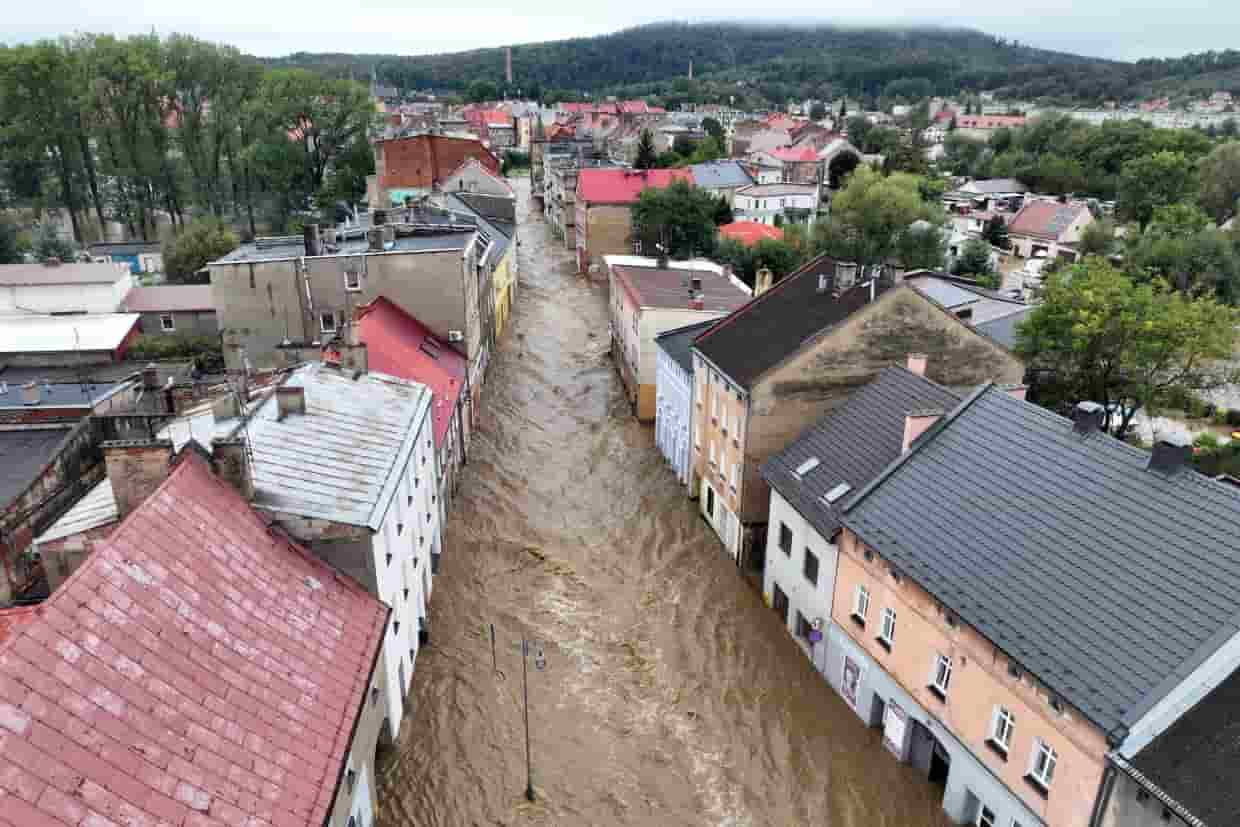

Central Europe continues to grapple with unprecedented flooding as Storm Boris unleashes destruction across several countries, leaving towns submerged and communities scrambling for safety. As the death toll rises and widespread evacuations are ordered, the region faces one of its worst weather disasters in recent memory.
Mass Evacuation in Nysa, Poland
The city of Nysa, home to 44,000 residents in southwestern Poland, has been at the forefront of the crisis. On Monday, the city’s mayor, Kordian Kolbiarz, issued a stark warning, urging all residents to evacuate immediately.
His plea came in response to the increasing threat of a nearby embankment breaching, potentially unleashing a catastrophic wave of floodwater from a nearby lake.
Kolbiarz made the evacuation announcement through social media and official channels, describing the grim situation: “Please evacuate your belongings, yourselves, your loved ones. It is worth getting to the top floor of the building immediately, because the wave may be several metres high. This means that the whole town will be flooded.”
Residents rushed to higher ground, hastily packing up belongings and rescuing pets, as soldiers and emergency personnel deployed to help with evacuations. The situation remains tense, with fears mounting that the embankment will give way, sending a cascade of water through Nysa’s streets.
In nearby Paczków, another southwestern Polish town, officials also sounded alarms. The mayor urged residents to leave their homes after water levels in a local reservoir began rising dangerously. Across Poland, tens of thousands of people have been evacuated, including the entire staff and patients from a hospital in Nysa.
A Widespread Disaster Across Central Europe
The deluge caused by Storm Boris has affected several Central European countries. As of Monday, the death toll from the floods had climbed to at least 16, with seven fatalities reported in Romania alone. Fatalities have also been recorded in Austria, the Czech Republic, and Poland, where the rapid swelling of rivers and waterways has caught many off guard.
In Slovakia, the overflowing Danube River has wreaked havoc in the Old Town of Bratislava, with water levels exceeding nine meters (30 feet) and still rising.
Local media reports suggest that parts of the Slovak capital have become almost unreachable as the river continues to surge. The Danube’s rising waters threaten to submerge large areas in neighboring Hungary, with the capital Budapest on high alert for potential flooding in the coming days.
Hungary has braced itself for the worst as warnings remain in effect along a 500-kilometer (310-mile) stretch of the Danube. The river has been rising by approximately one meter every 24 hours, prompting Budapest’s mayor to distribute one million sandbags to residents in an effort to reinforce flood defenses.
Hungarian Prime Minister Viktor Orbán announced via social media that he had postponed all international engagements due to the extreme weather conditions and the ongoing flood emergency in Hungary. “We must stand together in the face of this disaster. Our primary concern is the safety of our citizens and minimizing the damage,” Orbán stated.
Budapest officials have also prepared for transportation disruptions, with several tram lines suspended and roads along the Danube closing from Monday evening. Train services between Budapest and Vienna have been canceled as floodwaters make parts of the rail system impassable.
Austria and the Czech Republic: Inundated by Record Rainfall
While the storm has brought devastation to much of Central Europe, the Czech Republic and Austria have recorded some of the highest rainfall levels in decades.
In the northeastern Czech town of Jesenik, a staggering 473 millimeters (19 inches) of rain fell from Thursday through the weekend—five times the monthly average.
In response, the Czech fire service has been delivering bottled water to isolated villages after advising residents not to drink from taps or wells due to potential contamination caused by the floods.
Austria has not been spared either. In the town of St. Pölten, more rain has fallen in the past four days than in the entire autumn of 1950, which was previously the wettest on record.
Chancellor Karl Nehammer confirmed that the Austrian armed forces had been deployed to assist storm-hit regions, with military personnel engaged in rescue operations and flood defense reinforcement.
“We have never seen anything like this in our lifetimes,” Nehammer said. “Entire communities are being overwhelmed by the relentless rain and rising floodwaters.”
The Austrian government has pledged €300 million (£253 million) in emergency recovery funds, while most political parties have suspended campaigning for the federal elections, which are scheduled for September 29.
Meanwhile, floodwaters have isolated numerous villages in Romania, where mayors of hard-hit towns have described the flooding as catastrophic.
“If you were here, you would cry instantly, because people are desperate, their whole lives’ work is gone, there were people who were left with just the clothes they had on,” Emil Dragomir, mayor of Slobozia Conachi in eastern Romania, told the media.
Poland Declares a State of Natural Disaster
Poland has been hit especially hard, prompting Prime Minister Donald Tusk to declare a state of natural disaster.
Tusk has announced that one billion zloty (£197 million) will be allocated to assist flood victims. His government also plans to apply for additional relief from the European Union’s disaster fund.
Although floodwaters have begun to recede in some areas of Poland, such as the city of Kłodzko, where streets that were inundated on Sunday are now dry, many parts of the country remain on high alert.
Video footage from Kłodzko on Monday revealed the extent of the damage caused by the flood, with homes and businesses severely impacted by water damage.
Across the region, emergency response teams are working around the clock to shore up defenses and rescue stranded residents.
In the village of Rudawa, Polish rescuers were filmed carrying out pets and helping elderly residents to safety, as many homes were flooded. The response has been complicated by ongoing concerns about the potential for embankment breaches and more rain.
Budapest Prepares for Floods
In Hungary’s capital, authorities are racing against time to bolster flood defenses along the Danube. The river is expected to crest later this week, and the mayor of Budapest has urged residents to take advantage of the sandbags provided to reinforce their homes and businesses.
Emergency crews are also working to erect temporary barriers in the city’s most vulnerable areas. The Hungarian government has declared a state of emergency and mobilized additional resources to address the growing threat of flooding.
Some of Budapest’s most iconic landmarks, such as the Parliament building and Chain Bridge, are located along the Danube and are at risk of damage if the river breaches its banks.
In a show of solidarity, Prime Minister Orbán canceled all international engagements, vowing to focus his efforts entirely on managing the national crisis.
“We are facing an extraordinary situation, and every resource at our disposal will be used to protect our citizens and our capital,” Orbán said in a public statement.
The Path of Storm Boris: What’s Next?
As Storm Boris moves further south, its destructive power is expected to continue. The Emilia-Romagna region of Italy is set to receive up to 150 millimeters (6 inches) of rain in the coming days. Italian authorities are already preparing for the possibility of localized flooding as the storm reintensifies.
While much of Central Europe will see drier conditions from mid-week, it may take days or even weeks for floodwaters to fully subside in some areas.
Scientists have pointed to climate change as a key factor behind the extreme weather conditions, with the warmer atmosphere and oceans fueling more intense rainfall events.
Storm Boris has highlighted the growing vulnerabilities faced by Central Europe in an era of increasingly unpredictable and severe weather patterns. As the region begins to recover from the immediate devastation, the broader questions of how to adapt to these changing conditions loom larger than ever.
This article was created using automation technology and was thoroughly edited and fact-checked by one of our editorial staff members