



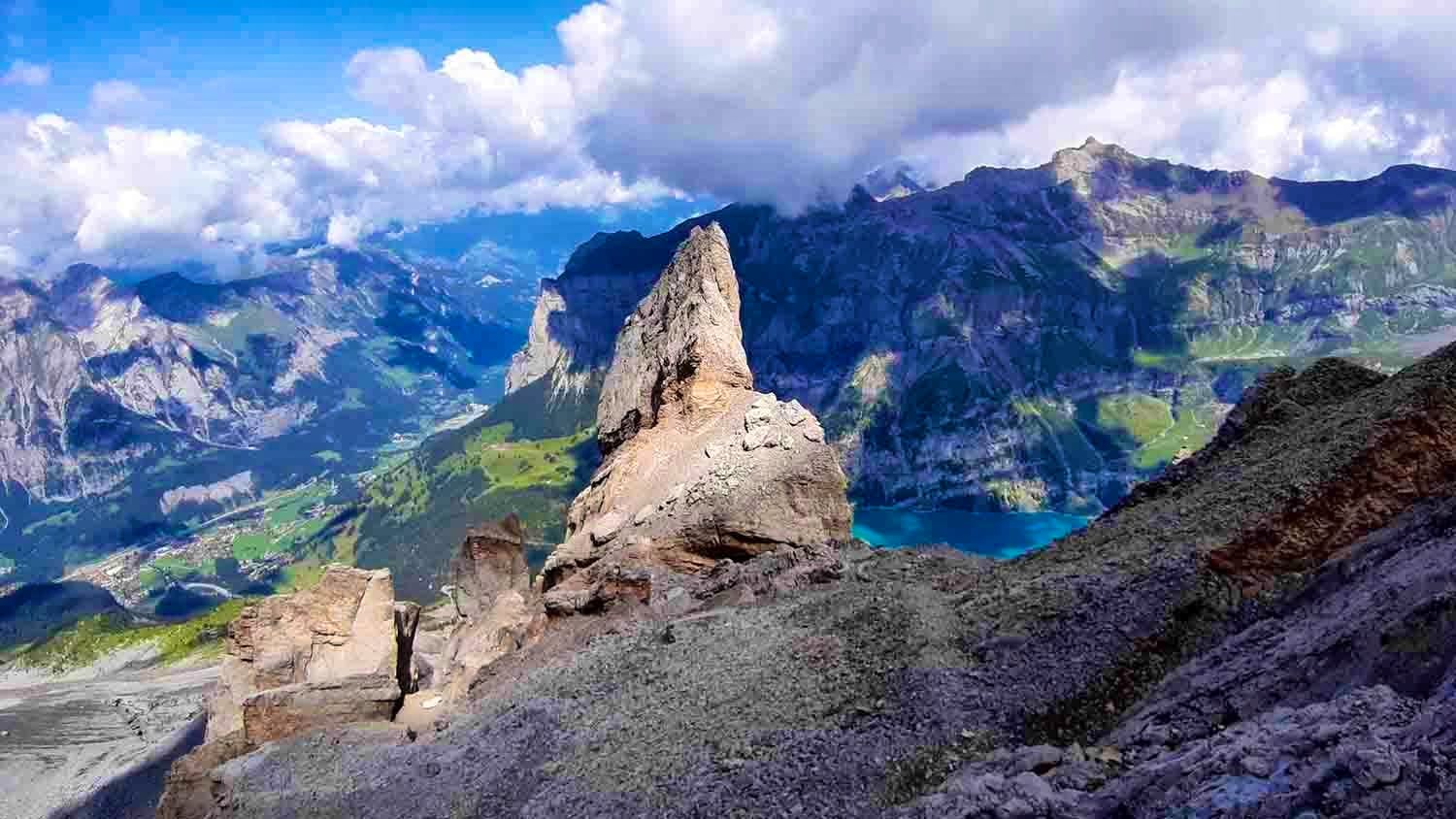

Switzerland, Bern Canton: Kandersteg confronts an unstable mountain threat as climate change accelerates glacier loss and weakens Alpine permafrost
KANDERSTEG, Switzerland — Beneath towering Alpine peaks and beside the turquoise waters of Lake Oeschinen, the Swiss village of Kandersteg is confronting a danger that has become increasingly difficult to ignore: an unstable mountain slope that could unleash a major landslide above the community.
Home to roughly 1,300 people, Kandersteg is surrounded by steep valleys, glaciers and dramatic rock faces. Above the village rises the Spitze Stei formation, where scientists have identified a vast unstable mass capable of producing a major rock avalanche and triggering a chain of dangerous natural events.
The unstable section is estimated to contain between 15 million and 20 million cubic metres of rock. Authorities and scientists have developed several scenarios for possible failures, ranging from smaller collapses to much larger events affecting areas around Lake Oeschinen and potentially sending debris and flooding towards Kandersteg.
The threat has become particularly significant following the catastrophic collapse at Blatten in Switzerland’s neighbouring Lötschental valley in May 2025. There, a huge mass of rock and ice descended from the mountainside after residents had been evacuated, burying much of the village beneath debris and mud.
Kandersteg, however, is not facing exactly the same circumstances as Blatten. Local residents have lived with rockfalls from Spitze Stei for years, while authorities have established monitoring systems, exclusion zones and emergency procedures designed to detect dangerous movements and provide time for evacuation if conditions deteriorate.
Residents describe a mixture of awareness and calm. Brigitte Jüni, who lives in the village, said people understand the danger without constantly fearing it. For many residents, the mountain is an unavoidable part of their surroundings rather than an immediate reason to abandon their homes.
Rudolf Isler, who was born in Kandersteg, has watched rocks fall from the mountain for years. He says residents are not necessarily frightened by Spitze Stei itself, but increasingly concerned about the wider environmental changes that are making Alpine slopes more unstable.
Those changes are closely connected to rising temperatures. Alpine permafrost contains frozen water that can help bind fractured rock and loose material together. As temperatures rise, that frozen ground can thaw, reducing stability and allowing water to penetrate cracks deeper into mountain slopes.
Scientists have increasingly linked the deterioration of glaciers and permafrost with changing conditions across the Alps. Markus Stoffel, a professor specialising in climate change and natural risks, has explained that ice within mountain debris can function like cement, meaning its disappearance can weaken slopes that were previously held together.
The Spitze Stei instability has been studied extensively since increased rockfall activity and large cracks became noticeable. Researchers have used geological surveys, satellite observations, GPS measurements, radar, cameras and other instruments to understand how the slope is moving and how its behaviour changes with weather conditions.
Researchers from Switzerland’s Federal Institute for Forest, Snow and Landscape Research have investigated whether thawing permafrost contributed to the destabilisation. Their work also examines how the slope could respond to heavy rainfall, changing temperatures and different possible failure scenarios in the future.
The danger does not necessarily end when rocks leave the mountain. A large collapse could affect Lake Oeschinen, potentially displacing water and generating waves. Rock and debris could also enter channels below the lake, creating debris flows that could travel downstream towards the valley and threaten infrastructure.
According to research on the hazard, a major failure could therefore produce several connected processes rather than one simple landslide. Rockfall could be followed by debris flows, while material entering waterways could potentially obstruct the Kander River and contribute to flooding farther downstream.
Authorities have responded by creating permanent exclusion zones and investing in protective infrastructure. The municipality has also established emergency planning and monitoring arrangements intended to ensure that people can be moved away from exposed areas if measurements indicate that a dangerous collapse is becoming more likely.
The mountain is monitored continuously because movement can change rapidly. Recent municipal information has reported ongoing movement at Spitze Stei, while also noting that inhabited areas were not considered at risk from the specific rockfall and debris-flow scenarios covered by its current assessment.
That distinction is important for residents. Although the mountain presents a serious long-term hazard, experts do not suggest that a catastrophic collapse is inevitable or imminent. The unstable mass may instead break apart gradually, with smaller failures occurring over time rather than one enormous collapse.
Local authorities therefore rely on early detection and evacuation rather than attempting to eliminate the mountain’s instability completely. Monitoring equipment provides information about movement, while hazard maps and evacuation plans help residents understand which areas could be affected under different scenarios.
For people living in Kandersteg, preparedness has become part of everyday life. Information leaflets explain evacuation routes, restricted areas and emergency procedures. The objective is to ensure that residents understand what to do without creating unnecessary alarm whenever ordinary rockfalls occur on the mountain.
The experience of Blatten has nevertheless intensified public attention. The 2025 disaster demonstrated how rapidly a mountain hazard can transform from a geological concern into a community emergency, while also highlighting the importance of evacuation planning when unstable slopes begin showing accelerating movement.
Scientists say climate change is adding another layer of uncertainty. Warmer temperatures affect glaciers, snow cover, rainfall patterns and permafrost simultaneously, potentially altering the conditions that have historically helped stabilise high mountain environments throughout Switzerland and other Alpine countries.
Switzerland has experienced substantial glacier losses in recent years. The rapid retreat of Alpine ice is significant not only for water resources and landscapes but also because glaciers and frozen ground form part of the complex natural systems that influence the stability of mountain terrain.
The consequences extend beyond Kandersteg. Across the Alps, communities situated below steep slopes face increasing challenges from rockfalls, landslides, avalanches and debris flows. Scientists warn that infrastructure designed under earlier climatic conditions may require increasingly expensive upgrades as hazards evolve.
Nathan Solothurnmann, a climate and energy expert with Greenpeace Switzerland, has warned that climate change could eventually make some Alpine valleys and villages increasingly difficult to inhabit. In some places, he argues, the cost of protection could become extremely high.
His warning reflects a broader question facing mountain communities: how long can settlements remain economically and physically viable when natural hazards intensify? Kandersteg’s situation demonstrates that adaptation may require continuous monitoring, stronger infrastructure, emergency planning and potentially difficult decisions about where development should continue.
For now, residents are staying. Tourists continue to visit the spectacular landscape around Lake Oeschinen, while authorities maintain restrictions in hazardous areas and scientists continue measuring movements on the mountain. The village remains open, even as Spitze Stei watches over it from above.
The uncertainty is perhaps the most difficult part of the situation. Scientists cannot determine precisely when a major failure might occur or exactly how much material could move. What they can establish is that the slope is unstable and that environmental changes are influencing its behaviour.
Kandersteg’s residents have therefore adopted a pragmatic relationship with the mountain. They know that rocks have fallen before, understand that larger failures are possible and recognise that climate change is reshaping the environment around them, yet they continue with ordinary village life.
The warning from Spitze Stei ultimately reaches far beyond one Swiss community. As temperatures rise and Alpine permafrost continues to thaw, mountains that once appeared permanently frozen and stable are becoming more dynamic, forcing governments and residents to reconsider how communities can safely coexist with changing landscapes.
For Kandersteg, constant observation remains the first line of defence. The mountain cannot simply be moved or repaired, and its enormous forces cannot be controlled. What authorities can do is monitor its movements, prepare evacuation plans and ensure that warnings reach people before danger arrives.
The village’s future will depend partly on how quickly those environmental changes progress and how effectively Switzerland adapts. For now, Kandersteg remains beneath the Spitze Stei, protected by preparation and vigilance while living with a mountain whose stability is increasingly being tested by a warming climate.
This article was created using automation technology and was thoroughly edited and fact-checked by one of our editorial staff members