



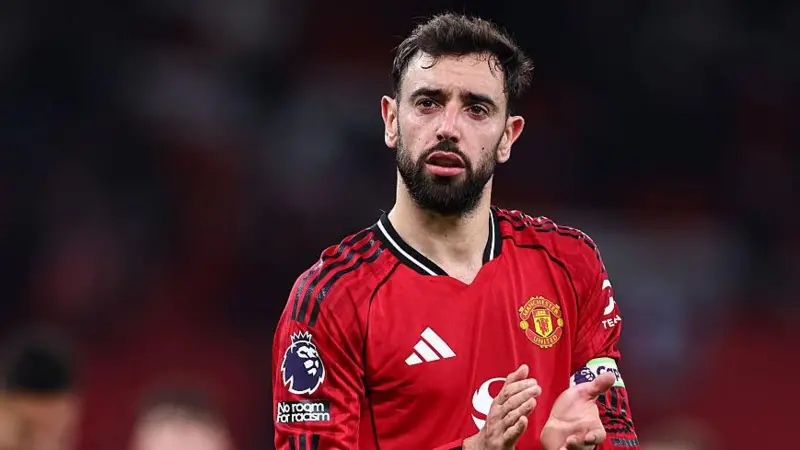

Manchester United captain Bruno Fernandes has opened up about the emotional turmoil he felt during the summer transfer window, revealing that the club’s apparent willingness to let him leave “hurt” him deeply.
The Portuguese midfielder, 31, said the episode occurred when Saudi Arabian side Al-Hilal submitted a staggering offer for his services. Reports suggest the Saudi club were ready to pay a fee of around £100 million, with wages reaching up to £700,000 per week.
Despite the financial allure, Fernandes made the decision to remain at Old Trafford, emphasising his loyalty to Manchester United and his desire to continue competing at the highest level in Europe.
Reflecting on the transfer saga in an interview recorded a few weeks ago with Canal 11, a Portuguese Football Federation-owned channel, Fernandes disclosed how the club’s stance affected him personally.
“From the club I felt it was, ‘If you go it’s not so bad for us’. It hurts me a bit,” Fernandes said, pointing to the emotional impact of feeling undervalued despite his importance to the team.
Fernandes joined Manchester United from Sporting Lisbon in January 2020 and has since become a pivotal figure in the squad, known for his leadership, vision, and goal-scoring ability.
The midfielder’s current contract runs until 2027, with an option for an additional year. Despite the ongoing speculation over his future, Fernandes stated in October—before reaching his 300th United appearance—that he will not discuss contract matters or potential moves until after the 2026 World Cup.
The summer approach from Al-Hilal highlighted the growing trend of European stars being courted by clubs in the Saudi Pro League, which has become increasingly aggressive in recruiting high-profile talent.
Fernandes’ decision to remain in England underscored his commitment to Manchester United, even in the face of one of the most lucrative offers of his career.
Fans and pundits alike have praised Fernandes for his professionalism and dedication, seeing his choice to stay as a statement of loyalty in a period when financial incentives often overshadow sporting considerations.
The midfielder’s comments also shed light on the sometimes-complicated relationships between players and their clubs. While fans may see a player’s decision to stay or leave in black-and-white terms, the personal and emotional dimensions are often overlooked.
Fernandes’ honesty in speaking about his hurt demonstrates a level of transparency not often shared publicly by players, highlighting the human side of the sport beyond transfers, contracts, and headlines.
Manchester United, meanwhile, are continuing to navigate a transitional phase, seeking to rebuild and compete at the top end of the Premier League. Fernandes’ leadership on the field remains integral to the club’s ambitions, and his rejection of Al-Hilal serves as a boost to supporters hoping for a resurgence.
As Fernandes prepares for the next chapter, including participation in the upcoming World Cup with Portugal, all eyes will remain on his performance at Old Trafford, where his influence both on and off the pitch continues to shape Manchester United’s present and future.
This candid revelation by Fernandes not only reinforces his loyalty but also provides a rare glimpse into the emotional challenges faced by elite footballers, where club decisions and personal aspirations often collide.
In conclusion, while the financial allure of Al-Hilal was significant, Bruno Fernandes’ choice to stay at Manchester United reflects a combination of professional pride, personal loyalty, and emotional investment in the club that has become central to his career.
This article was created using automation technology and was thoroughly edited and fact-checked by one of our editorial staff members