



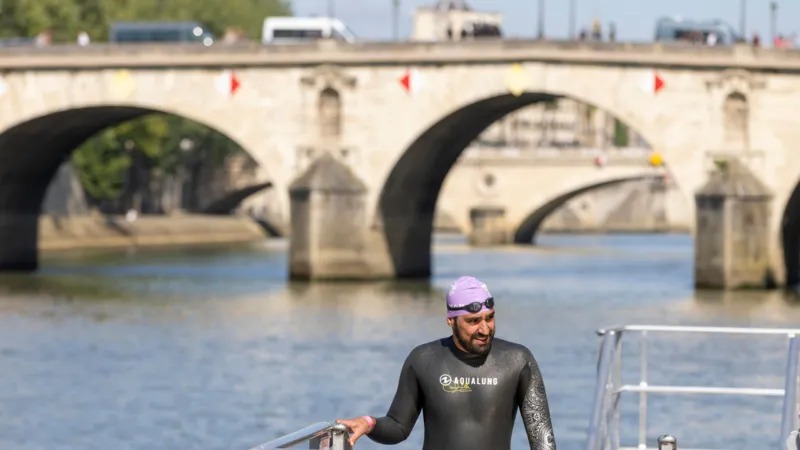

Paris, July 31, 2024 – The much-anticipated return of city swimming to the River Seine as part of the Paris 2024 Olympics has hit a snag, with the first triathlon event postponed by a day due to concerns over water quality.
This postponement casts a shadow over what was to be a dramatic centerpiece of the Games, which had aimed to bring competitive swimming back to the heart of the French capital after a century-long ban.
A Glittering Yet Problematic Venue
The River Seine, which had played a glamorous role in the Olympic opening ceremony with a boat parade featuring thousands of athletes under a rain-soaked sky, was set to host the triathlon events, marking a significant milestone in the city’s ambitious regeneration project.
Paris’s mayor, Anne Hidalgo, and other city officials have long championed the river’s revitalization as a legacy of the Games. However, recent weather conditions and water quality concerns have forced a delay in the schedule.
Standing on the Pont des Invalides, located slightly downstream of the triathlon’s planned starting line, a mix of locals and tourists shared their thoughts about the river’s swimability.
“It’s a beautiful river,” said Reda, a Parisian resident, as he surveyed the Seine shimmering under the summer sun. “But I will never dive in, even if they clean it for years.”
A Century of Swimming Ban
City swimming in Paris has been banned for a century due to concerns about the Seine’s water quality.
This restriction has become one of the key issues surrounding the Paris 2024 Olympics, as the Games were expected to showcase the results of a massive clean-up project aimed at transforming the river into a swimmable venue.
Recent heavy rainfall over the weekend exacerbated existing problems, leading to the river’s water quality falling below acceptable standards.
Paris’s single drainage system, which handles both wastewater and storm runoff, became overwhelmed, resulting in increased levels of contamination in the Seine.
Testing and Troubleshooting
Paris mayor Anne Hidalgo had previously demonstrated the progress of the clean-up by taking a swim in the Seine, a move intended to highlight the improvements made.
Despite this, testing on the river’s water revealed persistent levels of E.coli, a type of bacteria that can cause gastrointestinal illnesses such as vomiting and diarrhea. The presence of these bacteria exceeded the limits set by sports federations for safe swimming.
The BBC’s Hugh Schofield, who joined Hidalgo for a swim, reported accidentally ingesting some water but found it to be relatively tasteless.
Despite this, the testing results prompted officials to reconsider the safety of holding the triathlon event as originally scheduled.
International Perspectives
The issue of water quality in Paris is not unique. The European Environment Agency (EEA) recently reported that France lags behind the EU average in terms of top-quality bathing water conditions.
In 2023, about 75% of French bathing waters were rated as “excellent,” compared to the EU average of 85%. Coastal waters generally fare better than rivers and lakes, a fact highlighted in the EEA’s report.
Visitors to Paris from countries with better water quality standards expressed mixed feelings.
Esmee, a Dutch tourist, remarked, “I would go for it. It doesn’t look that bad from here.” Meanwhile, a Brazilian visitor indicated that, in his home city of São Paulo, water cleanliness is not a major concern when it comes to swimming.
Efforts and Back-Up Plans
The clean-up operation for the Seine, which has cost €1.4 billion ($1.5 billion), includes a substantial rainwater storage basin designed to hold the equivalent of 20 Olympic swimming pools of water.
This facility is intended to prevent sewage from entering the river during heavy rains. Despite these measures, the recent storm overwhelmed the system, leading to the triathlon’s postponement.
Lambis Konstantinidis, operations director for Paris 2024, assured that several contingency plans are in place.
“We have backup days allocated in the schedule, and only in a truly extreme case would we consider downgrading the triathlons to duathlons or canceling the swimming component,” he said.
Public Sentiment and Future Prospects
Despite the setback, there is still considerable public support for the river’s clean-up and the return of swimming to the Seine.
Danielle, a university professor, expressed her enthusiasm, saying she would “absolutely” swim in the Seine if given the chance. For many Parisians, a clean, swimmable river represents a long-awaited enhancement to their city’s quality of life.
Damien, another Parisian, noted the significance of maintaining the river’s cleanliness, describing it as “a big project” but one that offers a valuable opportunity for the city.
Local sentiment reflects a broader hope that, despite the current delay, the clean-up efforts will ultimately lead to a swimmable Seine and a successful Olympic legacy.
Conclusion
As Paris 2024 navigates this unforeseen challenge, the city’s commitment to transforming the Seine into a prime location for open-water swimming remains strong.
The postponement of the triathlon highlights the complexities involved in such a major urban revitalization project. Testing and remediation efforts will continue, with the hope that the river will soon meet the necessary standards for safe swimming.
In the meantime, athletes, officials, and spectators alike will have to wait for the rescheduled triathlon event, reflecting both the excitement and the ongoing challenges of hosting the Paris Olympics.