



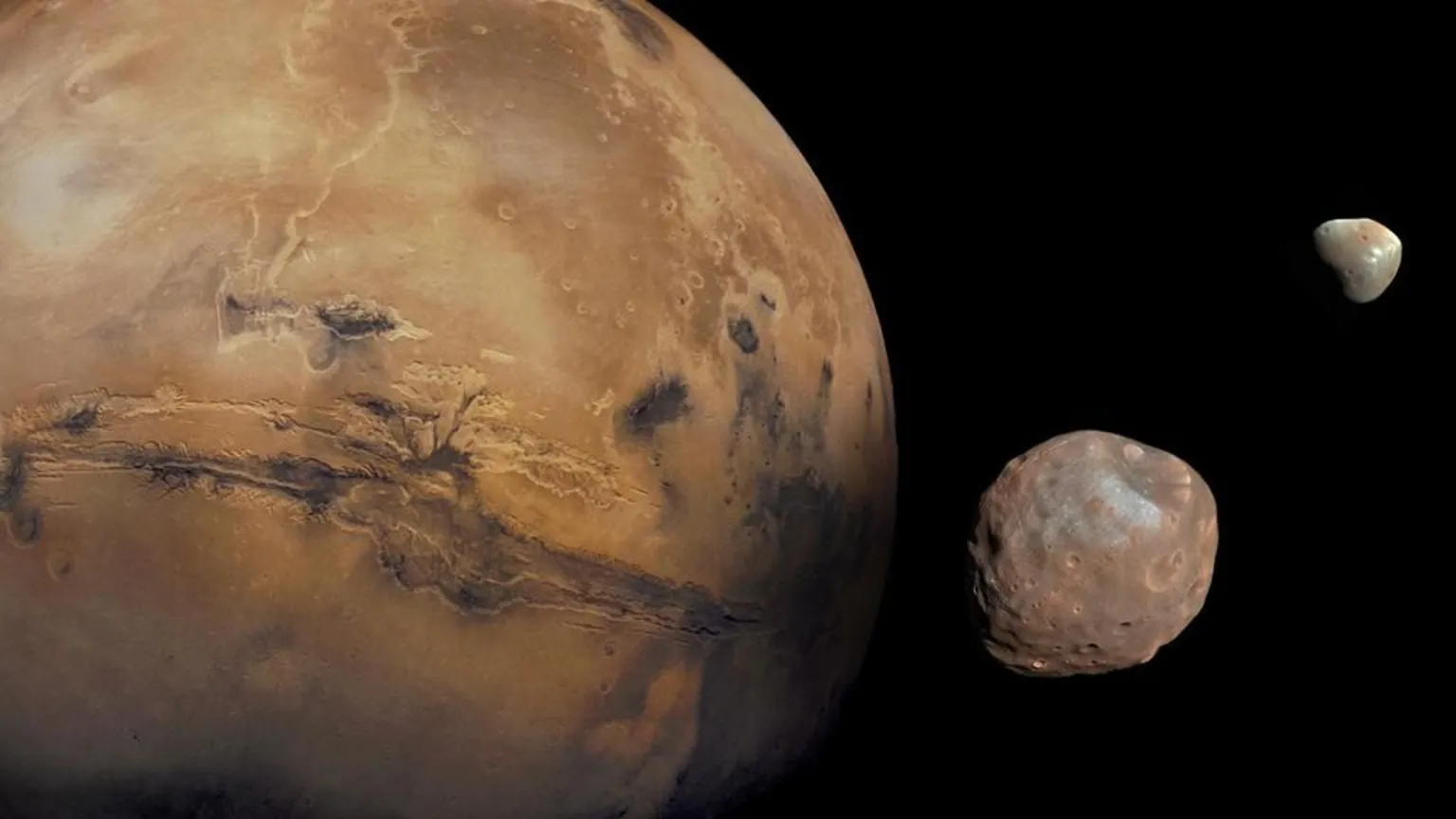

Japan’s MMX spacecraft launches from Japan, targeting Phobos as scientists pursue answers about Mars’ moons and their mysterious origins
Japan has launched a pioneering spacecraft toward Mars with an ambitious objective: collect material from Phobos and return it to Earth. The Mars Moons Exploration, or MMX, mission could transform scientists’ understanding of the mysterious Martian moons.
Led by the Japan Aerospace Exploration Agency, the mission is expected to reach Phobos in August 2027. After studying the Martian system, the spacecraft will concentrate on Phobos, preparing for a challenging landing and sample collection operation.
If successful, MMX would achieve a historic milestone in planetary exploration. It would become the first mission to return a physical sample from Mars or either of its moons, allowing scientists to study material directly inside laboratories on Earth.
Prof Sara Russell of the Natural History Museum, who serves as the mission’s deputy for sample analysis, described MMX as an exceptionally ambitious project. She noted that no previous spacecraft has successfully travelled to Phobos and brought material home.
Mars has two small natural satellites, Phobos and Deimos, which are dramatically different from Earth’s familiar Moon. Phobos measures roughly 20 kilometres across, while Deimos is only around 10 kilometres wide and both have irregular, potato-like shapes.
The MMX spacecraft will initially investigate Deimos while entering the Martian neighbourhood before turning its attention toward Phobos. Researchers hope observations of both moons will provide important clues about their physical properties, origins and relationship with Mars.
Landing on Phobos presents an extraordinary engineering challenge because the tiny moon possesses extremely weak gravity. At the same time, its close proximity to massive Mars creates a complicated gravitational environment that makes safely reaching the surface considerably more difficult.
The mission will deploy a small rover to investigate Phobos and help identify a suitable location for the spacecraft’s eventual landing. No rover has previously operated on a moon as small and gravitationally weak as Phobos.
Once the spacecraft reaches the surface, it will use a robotic arm and two sampling devices to gather material from Phobos. The collected dust and rock will then be sealed inside a capsule designed for the long journey back to Earth.
Scientists expect the returned sample to weigh only about 10 grams, an amount that may appear insignificant compared with terrestrial laboratory samples. However, researchers say individual grains can contain valuable chemical and mineral information capable of answering major planetary questions.
Dr Chrysa Avdellidou of the University of Leicester, who is involved with the Japanese mission, said scientists can conduct numerous investigations using even individual grains. The limited quantity therefore remains scientifically valuable, despite the enormous distance travelled.
The most important question surrounding MMX concerns the origin of Mars’ moons. Scientists currently consider two leading explanations, with one proposing that Phobos and Deimos formed from debris created after a massive impact struck ancient Mars.
The second possibility suggests that the moons were originally asteroids travelling elsewhere through the Solar System. According to this theory, Mars eventually captured them with its powerful gravity, leaving Phobos and Deimos trapped in orbit around the planet.
Returned material could provide a decisive answer because the competing theories predict different chemical and mineral compositions. Researchers will examine the samples in extraordinary detail, searching for signatures that distinguish Martian impact debris from captured asteroid material.
Russell expects the distinction could become apparent relatively quickly once laboratories receive the samples. Detailed chemical and mineral analysis should reveal whether Phobos formed from material connected directly to Mars or instead represents an object originating farther away.
The mission could potentially deliver an even more remarkable discovery. Because Phobos orbits extremely close to Mars, material blasted into space during impacts on the Martian surface could eventually travel across the short distance and become deposited on the moon.
That means some grains collected by MMX could actually originate from Mars itself. Scientists could therefore gain direct information about the Martian surface and its geological history without requiring the spacecraft to land on Mars.
The possibility is particularly exciting because obtaining uncontaminated Martian material has been a long-standing ambition for planetary scientists. Existing Martian meteorites provide valuable information, but they have been exposed to Earth’s environment after arriving naturally.
Mars meteorites are fragments of the planet that were launched into space by powerful asteroid impacts. Some eventually crossed interplanetary space and reached Earth, but once they landed, they were exposed to air, water, soil and other sources of contamination.
The MMX samples would offer scientists something fundamentally different: material collected directly from a planetary moon and sealed for controlled transportation. Researchers can then study its chemistry, minerals and possible Martian components under carefully controlled laboratory conditions.
NASA’s Perseverance rover has already been collecting and storing carefully selected samples on Mars since beginning its exploration in 2021. However, plans to return those samples through the joint NASA-European Mars Sample Return programme have faced major funding difficulties.
The planned NASA and European Space Agency sample-return effort has effectively been halted following funding decisions in the United States. This has increased attention on other international attempts to bring pristine Martian material back to Earth.
China is also developing an ambitious mission that aims to collect samples directly from Mars. Its planned launch in 2028 could attempt to return Martian material to Earth around 2031, potentially creating another historic chapter in planetary exploration.
For MMX, however, the immediate objective is Phobos rather than Mars itself. By targeting the tiny moon, Japan hopes to overcome significant technical challenges while potentially answering one of the Solar System’s longstanding questions.
The mission’s success would extend far beyond simply collecting a few grams of dust. Scientists could reconstruct part of Mars’ early history, determine how its moons formed and investigate whether Phobos contains material originating from the Red Planet.
The spacecraft is scheduled to return its precious sample to Earth in 2031, with the capsule expected to land in Australia’s Woomera region. Laboratories will then begin detailed examinations of material that has travelled billions of kilometres through space.
For planetary scientists, every grain will matter. The tiny sample could contain evidence preserved for billions of years, offering researchers an unprecedented opportunity to investigate Mars, its moons and the violent events that shaped the early Solar System.
As MMX begins its journey from Japan toward Mars, the mission represents a major international scientific effort built around an unusually small destination. If successful, Phobos could become the key to finally understanding the origins of Mars’ mysterious companions.