



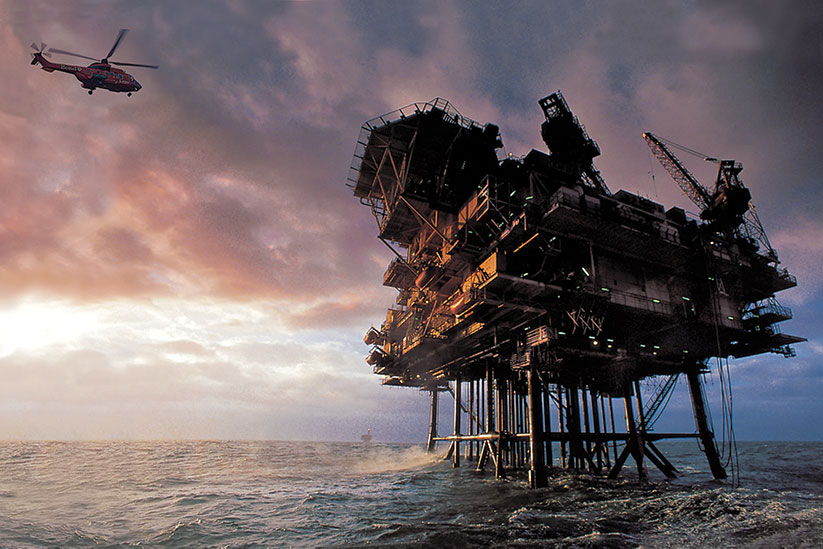

United Kingdom, Scotland: Hundreds of North Sea workers face job uncertainty as new helicopter weight rules approach mandatory implementation in November
Hundreds of North Sea offshore workers remain above a new helicopter travel weight limit, with companies facing a final push to help affected employees meet safety requirements before mandatory rules take effect across the industry in November.
From 1 November, offshore workers in the North Sea will generally need to weigh no more than 124.7kg, or 19.5 stone, including clothing and footwear, to travel by helicopter to offshore installations under the industry’s revised safety policy.
The requirement is designed around emergency rescue capability, particularly helicopter winches used to recover injured or stranded workers. Authorities have warned that rescue systems cannot safely lift people whose combined weight exceeds the maximum operational load during an emergency evacuation.
Industry body Offshore Energies UK, known as OEUK, previously estimated that more than 2,200 offshore workers exceeded the proposed threshold when the plans were announced. Updated figures now indicate that between 500 and 800 workers remain above the limit.
The latest figures represent significant progress, according to OEUK, with about 3.4% of offshore workers now above the threshold. That compares with an estimated 4.7% in 2022, suggesting hundreds of workers have successfully reduced their weight since preparations began.
The figures are based on more than 35,000 offshore traveller records collected between April and August. OEUK said the data showed a continuing downward trend, although the remaining workers face considerable pressure as the November implementation date approaches rapidly.
The policy defines weight as clothed weight, measured according to the industry’s travel clothing policy for the relevant season, including shoes. The calculation therefore reflects the weight of workers as they actually travel rather than their body weight alone.
The safety calculation is linked directly to helicopter rescue operations. The Coastguard rescue helicopter has a maximum winch load of 249kg, which must accommodate the person being rescued, a rescue worker, stretcher and essential equipment during an emergency.
OEUK says the calculation includes an average rescue worker weight of 90.3kg, equivalent to 14 stone, together with a 29kg stretcher and 5kg of rescue equipment. That leaves the remaining capacity for the offshore worker being lifted from danger.
The industry’s concern has grown alongside changes in workforce weight. OEUK said the average weight of offshore workers had increased by almost 10kg, or roughly 1.5 stone, since 2008, making emergency rescue capacity an increasingly important consideration.
The new requirement follows a lengthy review involving industry experts and safety considerations. It comes alongside earlier helicopter travel measures addressing passenger size, including rules concerning shoulder width and access to suitable windows for emergency escape.
Previously, passengers with shoulders measuring 22 inches, or 56 centimetres, or more were classified as extra broad. They were required to sit beside similarly large helicopter windows, helping ensure they could escape safely if an emergency landing occurred.
Weight has now become another major focus because offshore helicopters are essential for transporting workers to and from installations. The new policy is intended to ensure that emergency response arrangements remain viable for everyone travelling offshore, regardless of their role.
For affected workers, however, the change has created uncertainty about employment, health and their future in the offshore sector. Occupational health specialists say some workers worry about losing jobs if they cannot reach the required weight before November.
Dr Niyi Adeleke, an Aberdeen-based occupational health physician who assesses fitness for offshore work, said the issue had become a major topic of discussion among workers since the policy was announced last year and preparations intensified.
He said reactions had varied widely. Some workers were highly stressed and asking what changes they could make, while others were considering significant lifestyle adjustments. Occupational health assessments can include discussions about eating habits and practical approaches to sustainable weight loss.
Adeleke said some workers had considered weight-loss injections, while others had adopted more extreme approaches. He warned that some people were losing weight too quickly by fasting for prolonged periods, which he said was unlikely to provide a sustainable solution.
Some workers, he added, had decided to leave offshore employment rather than lose the required weight. Others were transferring abroad or moving into onshore positions, although he described those choosing to leave because of the policy as relatively few.
Many workers, however, are actively trying to meet the threshold. Adeleke said there were sustainable ways to lose weight and urged people affected by the rules not to lose hope, particularly while employers and occupational health professionals can still provide support.
The employment consequences could nevertheless be serious. Will Rollinson, an employment specialist at law firm Brodies, said employers would need to consider individual circumstances carefully before dismissing an employee who could no longer meet the offshore travel requirement safely.
Employers would need to assess what efforts the worker had made, why the target had not been achieved and what additional support might reasonably be provided. Companies could also consider whether suitable alternative onshore employment was available before termination became necessary.
Rollinson said some operators would have greater scope than others to offer alternative roles. The size and structure of an employer’s workforce could determine whether an employee could remain with the company while moving away from offshore duties.
Despite the possibility of job losses, the industry says there is still time for affected workers to make progress. OEUK health, safety and security manager Graham Skinner said between 500 and 800 workers remained above the limit with eight weeks remaining.
Skinner said the number was significantly lower than when the initiative began and described that reduction as a positive sign. Nevertheless, he acknowledged that substantial work remained to bring the remaining workers below the threshold before the policy became mandatory.
Under the new arrangements, a worker arriving at a heliport on 1 November above the 124.7kg limit will not be permitted to travel offshore. That means the final weeks before implementation could be critical for employees still trying to qualify.
Skinner said the industry’s assessment identified risks associated with worker weight throughout offshore operations. These included helicopter travel, confined spaces, working at height and, critically, the ability of rescue helicopters to winch workers to safety.
The central argument from the industry is that the limit is not intended simply as a workplace fitness requirement. Instead, it is tied to a specific rescue limitation, with the objective of ensuring that workers can be recovered when an emergency occurs offshore.
With the deadline approaching, companies and workers are therefore facing a shared challenge. OEUK is encouraging those still above the limit to begin or continue making sustainable changes, while employers may need to prepare alternative arrangements for people unable to qualify.
The debate also highlights a wider challenge for the offshore energy sector, where demanding working environments must be balanced against increasingly specific safety requirements. For affected employees, the next several weeks could determine whether they continue travelling offshore or pursue different roles.
As the 1 November deadline approaches, the industry is reporting measurable progress but remains focused on the workers still above the threshold. The immediate priority is reducing that number safely, while ensuring employment decisions are handled fairly and emergency rescue capability remains protected.
This article was created using automation technology and was thoroughly edited and fact-checked by one of our editorial staff members