



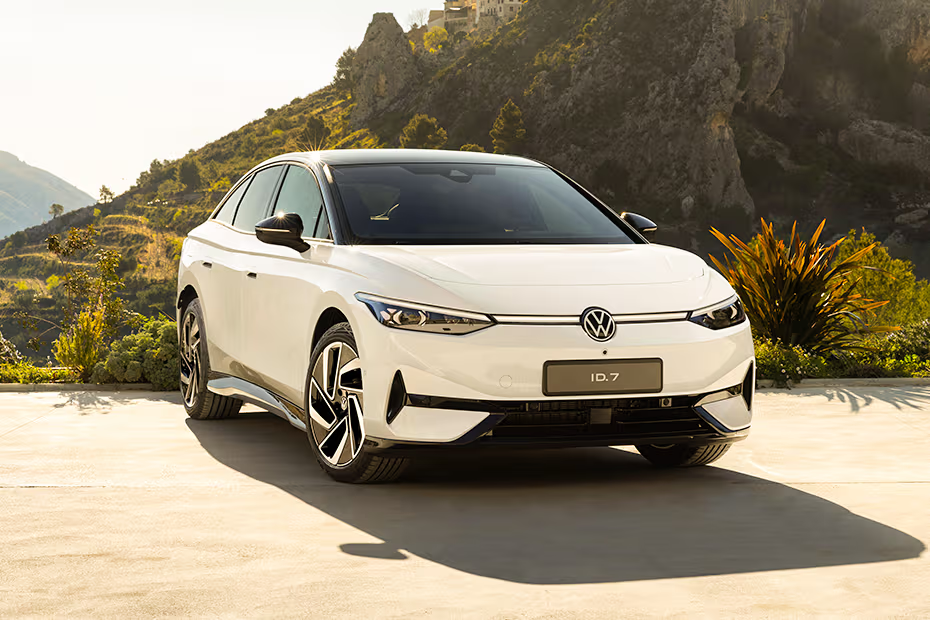

Germany is urging the European Union to tighten trade measures against Chinese carmakers as rising competition puts mounting pressure on Volkswagen and other major manufacturers
Germany’s Finance Minister Lars Klingbeil has called on the European Union to take a tougher approach toward Chinese carmakers, warning that growing competition is threatening Europe’s automotive industry and putting thousands of jobs at risk.
Speaking during a visit to Volkswagen’s headquarters on Thursday, Klingbeil said Germany could no longer afford to be naive in its economic relationship with China. He called for a more robust European response toward countries whose industrial policies threaten European companies.
“We cannot, when all is said and done, be naive in our dealings with China,” Klingbeil said after meeting Volkswagen employees, staff representatives and local politicians.
His comments came as Volkswagen faces one of the most difficult periods in its history. The German carmaker is undergoing a major restructuring programme, with job reductions expected to approach 100,000 over the course of the restructuring.
The crisis extends beyond Volkswagen. Mercedes-Benz and BMW are also reducing their workforces as Germany’s automotive industry struggles with weaker demand, high production costs and growing competition from Chinese manufacturers.
Berlin Targets Chinese Hybrid Vehicles
Klingbeil’s visit comes as Germany seeks changes to the European Union’s trade policy toward Chinese vehicles.
The EU introduced additional tariffs on Chinese-made electric vehicles in 2024 after concluding that Chinese manufacturers benefit from state subsidies that provide them with an unfair competitive advantage.
However, the measures do not currently cover plug-in hybrid vehicles. Chinese manufacturers have increasingly expanded their hybrid offerings in Europe, allowing them to increase their market presence without facing the same additional duties imposed on battery-electric vehicles.
Klingbeil said Germany would push Brussels for concrete measures covering plug-in hybrids as well as requirements concerning local content. Such rules could require manufacturers selling vehicles in Europe to source a larger proportion of components from European suppliers.
Daniela Cavallo, chair of Volkswagen’s supervisory board and a prominent representative of the company’s workforce, also backed extending trade measures to Chinese hybrids. “We find ourselves in enormously tough, difficult and unfair competition with China,” Cavallo said.
Chinese Brands Rapidly Expand Across Europe
The growing pressure on European manufacturers can be seen in the rapid expansion of Chinese car brands across the continent.
Chinese-brand vehicles accounted for only around 66,000 European sales five years ago. Their share subsequently increased to about 3% of the European market in 2023 and reached 6.1% in 2025.
During the first half of 2026, Chinese brands accounted for approximately 9.2% of European new-car sales.
The manufacturers are now on course to sell more than one million vehicles across Europe during 2026, marking a significant milestone in their expansion.
Several Chinese brands have already begun challenging established manufacturers in individual European markets and monthly sales rankings.
The rapid growth has been particularly noticeable in plug-in hybrids. Chinese manufacturers have increased their share of European PHEV sales from 2.5% to 13.7% in just one year.
The shift demonstrates how manufacturers have adapted their strategies following the introduction of EU tariffs on Chinese electric vehicles.
German Auto Workers Face Mounting Uncertainty
The trade dispute is closely connected to the growing concerns among German automotive workers.
IG Metall, Germany’s largest industrial union, has been engaged in a prolonged dispute with Volkswagen management over restructuring plans, factory operations and potential job losses.
Workers have staged strikes and protests at Volkswagen facilities across Germany, including plants in Zwickau and Hanover.
Further nationwide demonstrations involving automotive workers and suppliers are planned for Monday, increasing pressure on German policymakers to respond to the industry’s challenges.
For Berlin, the debate is therefore not simply about trade policy. It also concerns the future of one of Germany’s most important industrial sectors and the employment of hundreds of thousands of workers connected directly and indirectly to automobile manufacturing.
Klingbeil’s intervention signals growing pressure on the European Union to reconsider how its trade policies address Chinese competition, particularly as Chinese manufacturers continue expanding beyond electric vehicles.
The coming months could determine whether Brussels extends its existing measures to plug-in hybrids and introduces additional requirements for companies seeking access to the European market.