



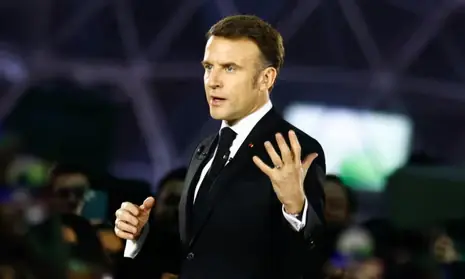

Paris, France – The growing influence of artificial intelligence (AI) on the environment and social inequality took centre stage at a high-profile global summit in Paris, where world leaders, tech executives, and experts gathered to discuss the technology’s far-reaching consequences.
French President Emmanuel Macron set the tone for the event by sharing a montage of deepfake images of himself on Instagram, including an AI-generated video of him dancing in a disco with 1980s hairstyles—an apparent nod to the capabilities and potential risks of AI-generated content.
The summit, which opened on Sunday, brought together policymakers and industry leaders to debate the dual challenges posed by AI: its environmental footprint and its role in widening global inequalities.
With AI-powered technologies such as deep learning models and data centres consuming vast amounts of energy, concerns over sustainability have intensified.
Meanwhile, discussions also focused on the risk of AI deepening economic divides, as wealthier nations and corporations benefit disproportionately from advancements in automation and generative AI.
AI’s Environmental Cost Under Scrutiny
One of the key themes of the opening exchanges was the environmental impact of AI.
As AI models become increasingly complex, they require massive computing power and data storage, leading to soaring electricity consumption and carbon emissions.
Experts at the summit highlighted that training a single AI model can generate as much carbon dioxide as five cars over their lifetime.
“AI has the potential to transform industries, but we cannot ignore its environmental cost,” said a climate scientist addressing the panel.
“Governments and tech companies must work together to develop greener AI solutions, such as more efficient algorithms and sustainable energy sources.”
With several European nations pushing for stricter environmental regulations, the discussion at the summit also reflected a growing demand for AI companies to adopt energy-efficient practices.
France, which has positioned itself as a leader in AI regulation, has been advocating for greater transparency from tech firms on their carbon footprints.
The AI Divide: A Growing Inequality Gap
Beyond environmental concerns, the summit also tackled the issue of inequality, with speakers warning that AI could exacerbate economic disparities both within and between nations.
The rapid advancement of automation has already displaced workers in various industries, raising concerns about job security, particularly in developing economies that rely on low-skilled labour.
A UN representative at the summit warned that “without proper safeguards, AI could deepen existing inequalities, leaving many behind in the digital revolution.”
Some panelists called for global AI governance frameworks to ensure equitable access to AI technologies and prevent monopolization by a handful of tech giants.
French President Macron’s use of deepfake imagery to promote the summit underscored the growing sophistication of AI-generated content.
While his post was meant as a lighthearted gesture, experts at the summit warned of the risks associated with deepfake technology, particularly its potential to spread misinformation and manipulate public opinion.
As the Paris summit continues, global leaders are expected to propose new regulations to address AI’s environmental impact and social inequalities.
The discussions reflect a broader push to balance AI’s immense potential with ethical responsibility, ensuring that the technology benefits all and does not come at the cost of sustainability or fairness.