



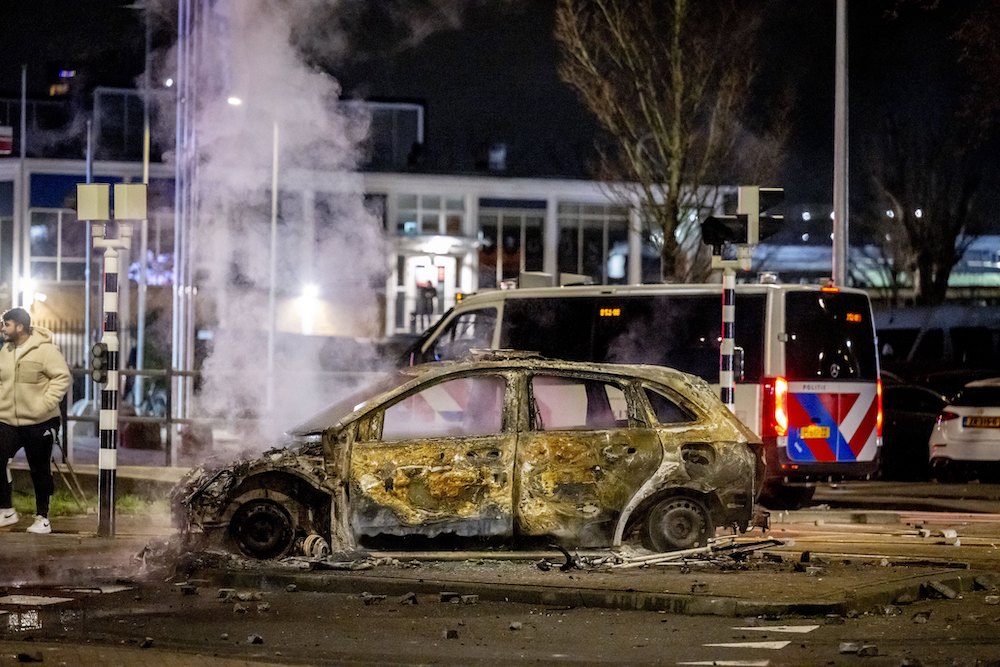

The Hague witnessed a night of chaos and violence as a gathering of the Eritrean community descended into a fierce clash between rival factions.
The confrontations left four police officers injured and several individuals arrested, prompting local authorities to denounce the incident as “unacceptable.”
The turmoil unfolded on Saturday night at the Opera business center, initially billed as a New Year’s party organized by pro-government Eritreans.
However, tensions escalated rapidly when opposing groups converged on the venue, sparking a violent altercation.
Eyewitnesses recounted scenes reminiscent of a battleground, with combatants wielding sticks, hurling paving stones, and even setting vehicles ablaze, including a coach.
Reports emerged of rioters assembling makeshift weapons, such as Molotov cocktails crafted from petrol-filled bottles obtained from a nearby station.
The aftermath painted a grim picture, with broken windows, shattered flower pots, and debris strewn across the streets.
City mayor Jan van Zanen condemned the upheaval as “disgusting and unacceptable,” pointing to pre-existing community tensions and heightened security measures undertaken for the event.
Authorities had received prior warnings about potential disturbances, particularly from the self-styled “Brigade Nhamedu,” a faction staunchly opposed to the authoritarian Eritrean regime.
The group, established in 2022, has been linked to similar disruptions at Eritrean community gatherings in other countries, including Sweden, Canada, and the United States.
Community spokeswoman Myra Koomen disclosed that the event drew a sizable crowd, estimating attendance between 500 and 600 individuals.
However, the festive atmosphere quickly soured as clashes erupted, leaving bystanders caught in the crossfire.
Acting justice minister Dilan Yesilgöz swiftly condemned the violence, emphasizing that targeting emergency service workers fulfilling their duties was “totally out of order” and would bear consequences.
The incident underscores deep-rooted divisions within the Eritrean diaspora, reflective of broader political tensions within the East African nation.
Eritrea has long been governed by an authoritarian regime under President Isaias Afwerki, prompting dissent and activism among diaspora communities worldwide.
As investigations into the unrest continue, authorities are faced with the challenge of quelling simmering tensions and preventing future outbreaks of violence.
The events in The Hague serve as a stark reminder of the complexities surrounding diaspora politics and the need for constructive dialogue to address underlying grievances.
In the wake of Saturday night’s mayhem, calls for unity and peaceful resolution resonate louder than ever, urging community members to transcend divisions and work towards a shared vision of stability and progress.
Only through collective efforts can the Eritrean community in The Hague and beyond navigate towards a future defined by harmony and resilience.
This article was created using automation technology and was thoroughly edited and fact-checked by one of our editorial staff members