



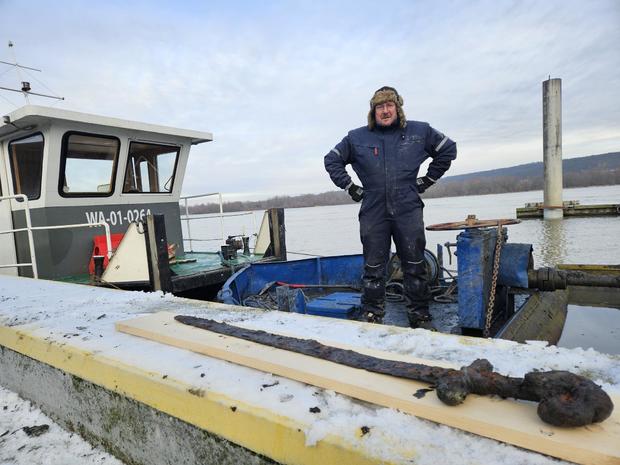

A medieval sword recovered from the depths of Poland’s Vistula River has sparked a wave of intrigue and speculation among experts, hinting at a potential Viking connection.
Unearthed during dredging activities at Włocławek port, the sword is one of eight weapons of its kind discovered in Poland, raising questions about its origins and historical significance.
The Provincial Office for the Protection of Monuments in Toruń, near the discovery site and a protected world heritage site, announced the find on Facebook, describing the sword as possessing a “mysterious inscription.”
Despite centuries of corrosion, preliminary analyses date the weapon back more than 1,000 years to the 10th century A.D., a period crucial to Poland’s history, coinciding with the formation of the House of Piast—the earliest known dynasty in the region.
Historically, swords with a simple, symmetrically extending blade, similar to those found, are linked to northwestern Europe, with ties to Scandinavian and Franconian cultures.
This connection provides historians with valuable insights into the medieval era, shedding light on the complex roots of Poland as a sovereign nation.
While Scandinavian influences are believed to have left their mark on Poland, the relationship between the Vikings and the contemporary Polish region remains a topic of interest for researchers worldwide.
The sword examined more closely under an X-ray scanner, revealed a hidden inscription beneath layers of corrosion. The inscription reads “U[V]LFBERTH,” potentially interpreted as “Ulfberht.”
This name is associated with approximately 170 medieval swords found mainly in northern Europe, dating back to the 9th, 10th, or 11th centuries.
Some experts speculate that “Ulfberht” may be a Frankish personal name, offering potential clues to the weapons’ origins.
However, only some are convinced of the Viking connection.
Robert Grochowski, a Polish archaeologist, emphasized that while these swords are commonly referred to as “Viking swords,” they were technically crafted in territories that now form part of Germany.
Grochowski suggested that the swords might have reached Central Europe, including Poland, through extensive trade networks, possibly involving Scandinavia.
“I don’t know where the idea that the sword belonged to a Viking comes from,” Grochowski cautioned against premature conclusions.
“Without detailed research, this is completely unjustified. It is difficult to say anything more than that it is an early medieval sword.”
The debate over the sword’s origin is set to continue as researchers plan to conduct further studies at Nicolaus Copernicus University in Toruń.
The goal is to unveil more about the historical context and significance of the weapon, providing a clearer understanding of Poland’s early medieval period.
The discovery aligns with ongoing efforts to piece together the intricate puzzle of Poland’s past, especially when the nation took its initial steps toward statehood.
The potential ties to the Vikings add an extra layer of fascination as researchers aim to explore the broader implications of such connections on the region’s cultural and geopolitical development.
Ultimately, the medieval sword, a witness to a bygone era, will be preserved and showcased at a history museum in Włocławek, offering the public an opportunity to marvel at this tangible link to Poland’s rich and enigmatic history.
As experts delve deeper into the mysteries concealed within the sword’s ancient metal, the saga of its origins is an absorbing chapter in the ongoing narrative of Poland’s archaeological heritage.
This article was created using automation technology and was thoroughly edited and fact-checked by one of our editorial staff members