




Iceland, Capital Region: Voters reject restarting European Union accession talks, prioritising control over fisheries and national independence despite growing Arctic security concerns
Iceland has voted against resuming negotiations on joining the European Union, rejecting a government proposal more than a decade after accession talks were suspended. The result represents another setback for supporters of closer European integration in the North Atlantic nation.
According to Iceland’s public broadcaster RUV, 52.8% of more than 225,000 voters rejected the proposal, while 47.2% supported restarting negotiations. Approximately 12,600 votes separated the two sides, demonstrating how closely divided Iceland remained over its European future.
The referendum attracted an unusually high turnout, with 82.5% of eligible voters casting ballots. RUV reported that participation was the highest recorded in any Icelandic election since 2009, underscoring the significance attached to the country’s relationship with Europe.
Around 270,000 people were eligible to vote in the referendum, held after Prime Minister Kristrún Frostadóttir’s centre-left government accelerated a planned vote. The government had originally promised to hold the referendum by 2027.
The decision to bring the referendum forward was partly influenced by heightened international tensions, including US President Donald Trump’s repeated interest in Greenland. Officials had warned that Iceland’s strategic position made European security relationships increasingly important.
However, security concerns did not dominate the campaign as extensively as some government supporters had expected. Instead, the debate focused heavily on domestic economic interests, particularly Iceland’s powerful fishing sector and the question of who should control its valuable marine resources.
Iceland already participates in Europe’s single market and the Schengen border-free area, giving it close economic and travel links with European Union countries. Full membership, however, would place Iceland within the EU customs union and eventually the eurozone.
The country’s relationship with the European Union has been complicated for years. Iceland formally applied for membership in 2009, following the devastating 2008 financial crisis and the collapse of its banking system, which severely affected the national economy.
Accession negotiations subsequently progressed considerably, with Iceland completing discussions on several important areas. Yet the political climate changed dramatically after a eurosceptic government came to power in 2013, deciding to suspend the negotiations rather than pursue full EU membership.
Fishing rights were already among the most contentious issues during those earlier negotiations, and they remained central to Sunday’s referendum. Iceland’s fishing industry is considered strategically and economically vital, making control over surrounding waters a particularly sensitive political issue.
Iceland’s fishing communities have deep historical memories surrounding control of marine resources. During the Cod Wars with Britain in the 1970s, Iceland successfully fought to expand its fishing jurisdiction and protect domestic fishermen from foreign competition.
Those conflicts became closely associated with Iceland’s struggle to safeguard national sovereignty following independence from Denmark. Today, fish and marine products remain major contributors to the country’s economy, accounting for almost 40% of Iceland’s exports.
Many voters opposing renewed EU negotiations feared membership could reduce Iceland’s ability to independently manage its fishing grounds. European Union rules determine how fishing opportunities are allocated among member states, raising concerns that Iceland could lose control over lucrative waters.
Political scientist Eirikur Bergmann of Bifröst University told the BBC that the No campaign successfully connected opposition to European integration with Iceland’s long history of independence. National identity therefore became a powerful argument against restarting negotiations.
According to Bergmann, supporters of the No campaign were particularly effective at appealing to deeply rooted feelings surrounding Iceland’s sovereignty. The country’s historical struggle for independence from Denmark continues to influence political attitudes toward international institutions and shared European governance.
By contrast, Bergmann said the Yes campaign adopted a largely technical approach. Supporters focused heavily on practical arguments without clearly communicating the broader purpose or emotional appeal of Iceland becoming a European Union member.
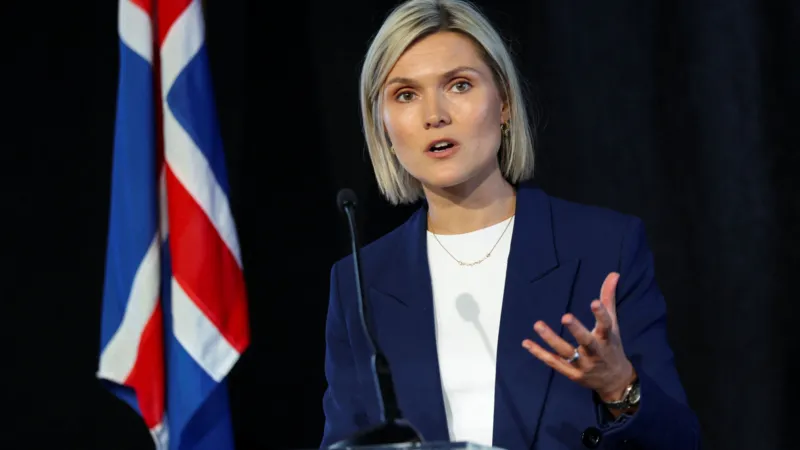
Prime Minister Kristrún Frostadóttir said the referendum campaign had generated an important national discussion about Iceland’s place in the international community. She cast her ballot in Reykjavík before the final result showed voters rejecting renewed negotiations.
Speaking at a news conference on Sunday afternoon, Frostadóttir said her government would not revisit the question of European Union membership during its time in office. The statement effectively closes the issue for the current administration.
A government minister rejected suggestions that the result represented a political setback, instead highlighting the exceptionally high turnout. Officials argued that the participation demonstrated strong public engagement with a question that could have shaped Iceland’s long-term international direction.
The result also revealed a significant geographical divide. Reykjavík and surrounding areas were more supportive of restarting European Union negotiations, while rural communities were generally more opposed, reflecting differences in economic priorities and attitudes toward national sovereignty.
The ballot question itself was narrowly focused: voters were asked whether Iceland should resume accession negotiations with the European Union. A Yes vote would not have meant immediate membership, but would have reopened negotiations toward a potential future agreement.
Any eventual accession agreement would have required approval through another referendum, meaning Sunday’s vote was not a final decision on whether Iceland should actually become an EU member. Likewise, the No result does not permanently prevent future governments from reopening negotiations.
Security nevertheless remained part of the broader debate. Iceland is a founding member of NATO but has no standing military, instead relying on its allies for national defence and participating in international security cooperation.
EU membership could also have provided Iceland with access to the bloc’s developing joint defence infrastructure. The issue gained additional relevance as Russia’s war in Ukraine and increased maritime activity around Iceland raised concerns about the country’s strategic vulnerability.
Iceland has strongly supported Ukraine since Russia launched its full-scale invasion. Officials have also monitored Russian maritime manoeuvres near Iceland, while broader tensions in the Arctic have increased attention on the island’s strategic location.
Trump’s expressed interest in bringing Greenland under US control added another dimension to Iceland’s security debate. Greenland, like Iceland, occupies an important position in the Arctic, making developments involving the territory increasingly significant for neighbouring Nordic countries.
Iceland’s Foreign Minister Katrín Gunnarsdóttir said after the referendum that she would seek to strengthen the country’s defence relationships with other nations. Her comments indicated that the government intends to address security concerns despite the rejection of renewed EU negotiations.
Bergmann, however, argued that international developments had relatively little influence on the referendum. He said the debate remained firmly focused on domestic questions and that global upheavals had not substantially penetrated the campaign.
European officials expressed disappointment at the outcome. Jacob Funk Kirkegaard, a senior fellow at the European think tank Bruegel, said the European Union had failed to effectively present itself as a security actor, particularly in relation to the increasingly important Arctic region.
An unnamed European Union diplomat told Reuters that the result represented a clear setback for Brussels. The diplomat nevertheless acknowledged that fishing rights and concerns about Icelandic independence were decisive factors behind the rejection.
The result was welcomed by eurosceptic politicians across Europe. Reform UK leader Nigel Farage, one of the prominent figures associated with Britain’s departure from the European Union, praised Icelanders for choosing what he described as continued independence.
France’s National Rally leader Marine Le Pen also welcomed the result, arguing that European Union membership should not be considered the inevitable destination for every European democracy. Her comments reflected wider eurosceptic reactions across the continent.
For Iceland, however, the referendum leaves the country’s European relationship largely unchanged. It will remain closely connected to the EU through the single market and Schengen arrangements while retaining independent control over areas such as fisheries.
The vote ultimately demonstrated that economic integration and security considerations remain secondary to sovereignty for many Icelanders. Although the international environment is changing rapidly, the country’s historic attachment to independence continues to shape its political choices.
With accession talks now unlikely to return under Frostadóttir’s government, Iceland’s European question has once again been placed on hold. Whether a future administration attempts to revive negotiations will depend on changing domestic politics, economic interests and developments across Europe.
This article was created using automation technology and was thoroughly edited and fact-checked by one of our editorial staff members