



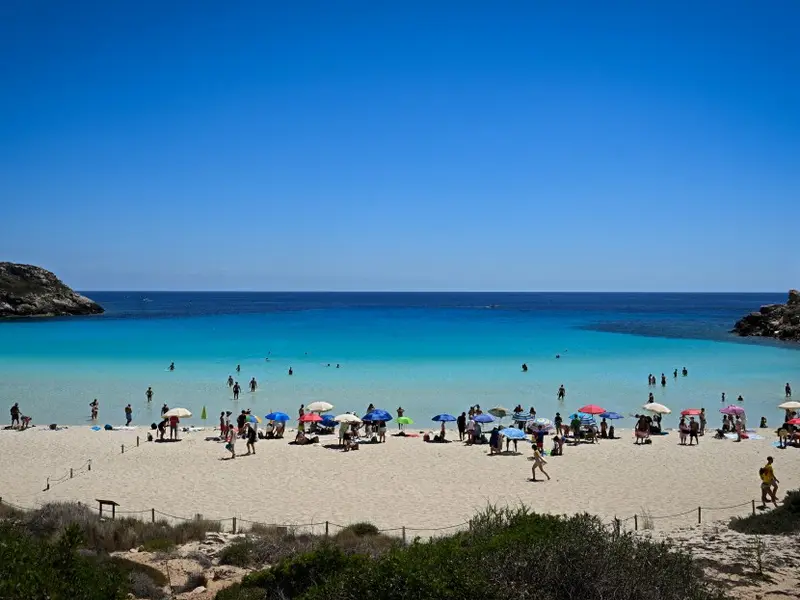

Italy, Friuli-Venezia Giulia: Historic Trieste beach draws record crowds after renewed debate over its century-old gender separation policy
La Lanterna beach in Trieste has found itself at the centre of an unusual summer controversy, after criticism of its long-standing gender-separated bathing policy was followed by a remarkable rise in visitors during July, according to local reports.
Officially known as Bagno Marino La Lanterna and popularly called Pedocin by residents, the municipal bathing facility is one of Trieste’s most distinctive landmarks. Its unusual arrangement divides bathers into separate male and female sections, preserving a tradition dating back to the early twentieth century.
The beach is divided by a substantial wall extending into the sea, physically separating the two areas. Women and children up to 12 are accommodated on one side, while men use the other, according to information published by Trieste’s municipal authorities and tourism officials.
The arrangement has survived despite changing social attitudes and the disappearance of similar facilities elsewhere. Supporters argue that the division is not simply a bathing rule, but an important part of Trieste’s identity and a surviving reminder of the city’s distinctive coastal history.
The controversy intensified in June when a visiting couple from Milan became involved in a confrontation after entering an area reserved for men and women. The dispute quickly escalated, drawing intervention from beach staff before the tourists eventually departed.
According to reports, the visitors strongly objected when they were asked to respect the beach’s established separation. They described the arrangement as discriminatory and medieval, turning what might ordinarily have been a disagreement over local rules into a broader public argument.
The incident quickly spread through Italian media and social networks, prompting competing reactions from people who viewed the policy either as an outdated form of segregation or as an unusual cultural tradition worth preserving for future generations.
Several Trieste residents defended La Lanterna, arguing that visitors should understand the rules before entering a facility that has maintained its distinctive division for generations. Some online commenters accused critics of attempting to erase a historical feature associated with the city.
The debate also highlighted an important feature of the beach’s design. Because the separating wall does not prevent bathers from reaching the water beyond it, people on opposite sides can meet by walking through the shallow sea around the end of the barrier.
For some women, the arrangement also provides a degree of privacy that mixed beaches do not necessarily offer. The women’s section has traditionally allowed visitors to sunbathe topless without being directly visible to men on the other side of the dividing structure.
Despite the criticism, the controversy does not appear to have damaged the beach’s popularity. Instead, figures reported by local newspaper Il Piccolo suggest that the attention generated by the dispute coincided with a substantial increase in visitors during the height of Italy’s summer bathing season.
La Lanterna reportedly sold 53,610 tickets during July, compared with 34,885 tickets during the same month last year. That represents an increase of 18,725 admissions, meaning visitor numbers were more than 50 percent higher than the corresponding figure recorded previously.
Women reportedly accounted for the majority of the additional customers, an especially notable development given that the controversy itself centred partly on whether gender separation remains appropriate in contemporary public spaces.
The surge illustrates how controversy can sometimes produce the opposite effect from what critics expect. Instead of discouraging visitors, national and international attention appears to have encouraged curiosity about a beach that many people outside Trieste had never previously encountered.
The facility is also relatively inexpensive. According to Trieste’s municipal government, the daily admission price during the 2026 bathing season is €1.20, while children under certain age limits can enter without charge when accompanied by a paying adult.
La Lanterna operates as a municipal facility and offers practical amenities including toilets, showers, changing areas, first-aid facilities and accessibility provisions. Bathing is permitted seasonally, with lifeguard services operating during the designated swimming period.
Its location also contributes to its continuing appeal. Situated at Molo Fratelli Bandiera in Trieste, the facility provides residents and visitors with access to the sea without requiring a journey to distant coastal resorts.
The beach’s history stretches back more than a century, although official tourism information differs slightly over the precise opening date. Italy’s national tourism portal describes the lido as having opened in 1890, while the current controversy and other accounts commonly associate its established gender-separated tradition with the early 1900s.
That long history is central to the argument made by supporters. For them, removing the wall would not simply change a beach rule; it would eliminate one of Trieste’s most recognisable and unusual institutions, which has continued operating while surrounding social conventions have changed.
Critics, however, question whether historical importance should be sufficient justification for maintaining separate public spaces for men and women. The June confrontation demonstrated how unfamiliar the arrangement can appear to visitors who encounter it without knowledge of Trieste’s local traditions.
The dispute therefore reflects a wider question facing historic public institutions across Europe: whether unusual customs should be preserved because they represent cultural heritage, or changed when modern social expectations increasingly challenge their original purpose.
For now, there is little indication that La Lanterna’s basic arrangement is about to disappear. The municipal authorities continue to officially describe the facility as divided into separate male and female sections, confirming that the controversial system remains in operation.
Rather than fading from public attention, the controversy appears to have transformed La Lanterna into an even more talked-about destination. Thousands of additional visitors have arrived, with many apparently curious to experience a beach whose unusual tradition has suddenly become an international talking point.
The result is an unexpected twist for a place caught between tradition and modern expectations. What began as criticism of gender separation has instead generated publicity, increased visitor numbers and renewed interest in one of Trieste’s most distinctive pieces of living history.
This article was created using automation technology and was thoroughly edited and fact-checked by one of our editorial staff members